Mark Easterbrook
The Pale HorseMark Easterbrook is the narrator-investigator through whose growing attention the apparently separate clues surrounding the Pale Horse begin to form a case. A scholar initially absorbed in a book on Mogul architecture, he becomes involved in an inquiry into murder as a business: he reconstructs the trail of names, joins forces with others to act, and identifies thallium poisoning as the likely cause of Ginger’s illness. His movement from detached observer to participant supplies the investigation with both its organizing perspective and its decisive medical inference.
Identity and Narrative Position
Mark identifies himself as the person writing most of the narrative, and considers where its history should begin: with Father Gorman setting out to visit a dying woman, or with an earlier evening in Chelsea. This choice makes the account’s beginning part of its subject. The narrative does not simply follow clues in sequence; it shows Mark deciding which moment makes their later connection intelligible.
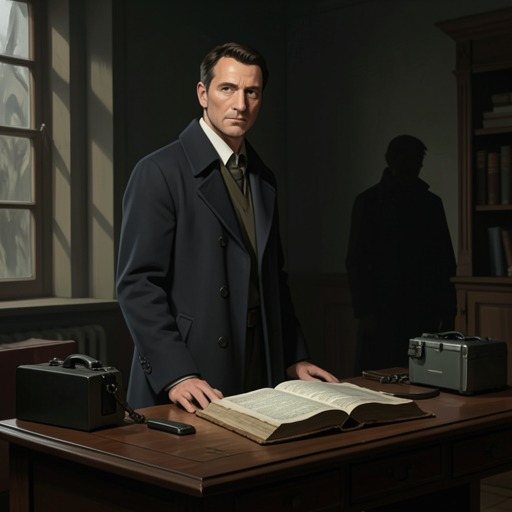
At the time of that Chelsea evening, he has rented a furnished flat there for three months but remains a stranger to the neighborhood. His work on Mogul architecture could have been done from Hampstead, Bloomsbury, Streatham, or Chelsea; his surroundings matter little to him, and he describes himself as existing in a world of his own. A sudden revulsion against his subject interrupts that scholarly absorption. The change is not yet an investigation, but it marks a departure from the self-contained life that has occupied him.
His account begins with contemporary sounds, including an espresso machine whose hiss seems to him sinister. He broadens the image to jet planes, a tube train, road transport, and domestic appliances, imagining their noises as warnings about the risks of losing control of things made to serve people. This framing gives the opening a specific tension: modern life appears both useful and potentially alarming. Mark’s later inquiry likewise turns on the possibility that ordinary, controlled systems can conceal dangerous purposes.
From Clues to a Case
Mark’s own reconstruction begins with a casual remark by Poppy: the Pale Horse was a place to go if someone wanted to get rid of another person. He then connects that remark to his meeting with Jim Corrigan, who showed him a list of names associated with Father Gorman’s death. The list includes Lady Hesketh-Dubois and a Tuckerton; another name, Delafontaine, seems familiar because Mrs Oliver had mentioned a sick friend who has since died. These are not yet proofs of a common scheme. They are the disparate details Mark tries to place in relation to one another.
His response to the uncertainty is to revisit Poppy. He recalls going to her among the flowers after the Pale Horse had been mentioned, and her emphatic denial that she knew of such an institution. To Mark, the fear accompanying that denial is more significant than the denial itself. The clue is therefore not only a name or statement, but a change in how he reads a person’s reaction.
Later, while trying to sort out his ideas after a meal, he mentally retraces the sequence. When Mrs Dane Calthrop observes that something must have happened before a woman’s influence could explain his state of mind, Mark agrees and gives her a concise account of Father Gorman’s murder and the casual nightclub mention of the Pale Horse. He also produces the list he copied from the paper Jim Corrigan showed him. Mrs Dane Calthrop’s attention to the names turns his private chain of recollections into a shared inquiry.
Commitments and Relationships
Mark’s association with Ginger develops into an investigative partnership rather than a purely playful adventure. Ginger acknowledges that Mark brought her into the matter, but insists that the question of who began first is no longer important: both are involved, and the suspected enterprise must be stopped if their understanding is correct. Her distinction gives Mark’s inquiry a moral and practical focus. The suspected murders are not described as crimes arising from hatred, jealousy, or an individual’s direct pursuit of gain, but as a business that takes no account of who the victim is.
Mark also brings the inquiry to Inspector Lejeune and argues for direct observation. He accepts that the supernatural can appear supernatural while also entertaining the possibility that future science may explain what currently seems beyond explanation. He proposes going to see what actually happens; when Lejeune looks at him, Mark adds that the way is already paved. The exchange presents him not as claiming certainty, but as willing to test the claim by entering the situation himself.
A brief encounter with Mrs Tuckerton shows another way Mark uses personal recollection to check the names against people. He abruptly says that he believes he once met her daughter—or stepdaughter—and she identifies Thomasina as the person he means. The exchange supplies a small but concrete link between the list and Mark’s earlier social experience, without establishing more about that meeting than his recognition.
Recognition and Narrative Function
Mark’s most consequential inference in the cited episodes comes when Ginger is ill. Asked whether her hair is coming out by the roots in handfuls, he treats that symptom not as a consequence of fever but as evidence of thallium poisoning. His diagnosis places Ginger’s condition alongside the illnesses he believes the other victims suffered and makes the danger immediate: he hopes they may still be in time. The scene shows the investigation moving from names and suspicions to a proposed physical explanation, while leaving the outcome unresolved at that moment.
Across these stages, Mark’s function is to turn scattered information into an intelligible sequence without pretending that suspicion is proof. He begins as an outsider to Chelsea and as a scholar whose chosen subject has suddenly lost its hold on him. Poppy’s warning, Jim Corrigan’s list, Mrs Dane Calthrop’s questions, Ginger’s insistence on shared responsibility, and Ginger’s symptoms progressively alter his position. He becomes the person who carries the clues between conversations, tests the possibility of the Pale Horse’s methods, and recognizes the poison that may connect its victims. The narrative’s movement from scholarly distance to urgent diagnosis gives his changing involvement its shape.